
Internal case study · MitUP & Me Consulting (Biz2People)
SecretarIA is a Claude-powered operations layer — Claude Cowork skills for the judgment calls, a standalone Claude API service for always-on capture — that turns email, WhatsApp, social links and meeting recordings into the same operating rhythm, without asking anyone to open one more app.
The problem: management context was scattered across five tools that didn’t talk to each other
A two-country consulting practice runs its week across Outlook, WhatsApp, meeting recordings, a ClickUp workspace, and whatever half-formed idea someone just saw on LinkedIn. Each tool did its job. None of them shared what they knew. Decisions from a meeting stayed in a transcript nobody reread; a good idea shared in a chat message stayed in that chat message.
Objectives: nothing new to check — just nothing thrown away
The brief was practical, not visionary: stop meeting decisions from disappearing into a transcript nobody reopens; stop a good idea, wherever it turns up, from being lost the moment the conversation moves on; get the inbox worked through before the day’s first meeting instead of after; and give a practice split across Portugal and Brazil one place to check what was actually decided, instead of five. None of it was about replacing anyone — only about making sure nothing anyone already does gets thrown away.
What it is: not one bot — a set of narrow skills under one rulebook
SecretarIA isn’t a single assistant with a big prompt. Most of it is a growing set of purpose-built Claude Cowork skills, each with one job and a natural-language trigger, operating under a shared rules-of-engagement skill that governs what runs on its own and what waits for a person. One piece runs differently on purpose — see “Built like production” below.
- secretaria-ideias-triar — triage the queue. Works through everything captured — from WhatsApp, from a meeting, from anywhere — and routes it to where it belongs. Trigger: “tria as ideias”.
- secretaria-ideias-anotar — capture on the spot. Logs a stray idea, note or task — no triage, no gate, from any project or chat. Trigger: “anota isto”.
- 5 × secretaria-ideias-extrator-* — read a social link before it’s filed. Facebook, Instagram, LinkedIn, Threads and TikTok links get pulled and enriched before landing in the queue — no metrics, no comments, just the content. Trigger: any social link dropped into a chat.
- secretaria-atas-escriba — write a meeting record. Drafts minutes from a call recap against a shared structure — the same shape every time. Trigger: a Teams recap link.
- secretaria-atas-leitor — query a past meeting. Answers what was decided and what’s still open, without anyone rereading a transcript. Trigger: “what came out of meeting X?”
- secretaria-teia-escrita — write to the knowledge graph. Links people, decisions and topics into teia — institutional memory that outlives any one thread. Trigger: “regista na teia”.
- secretaria-reconciliador — reconcile the graph. Checks what’s captured against what’s actually in the graph, and closes the gap. Trigger: “o que falta na teia?”
- secretaria-triagem-email — pre-triage the inbox. Runs on a fixed early-morning schedule, before the day’s first meeting. Trigger: runs on its own every morning.
Integrations: wired into the tools the company already runs — not a demo environment
Every connection below is the real, daily-use system: the same Outlook mailbox, the same ClickUp workspace, the same WhatsApp number the team already had. SecretarIA sits inside that stack instead of asking the company to move into a new one.
- Microsoft Outlook / Graph — triage, drafting, folder routing
- WhatsApp — idea capture, and enrichment of shared Instagram, Facebook, LinkedIn and TikTok links
- ClickUp — docs, tasks, assignees
- teia — self-hosted knowledge graph
Architecture: every arrow is either an API call or a Cowork skill — and ClickUp runs both ways
The wiring behind the integrations above, drawn out: which tool feeds which entity, by which mechanism, and how teia gets built and kept current.
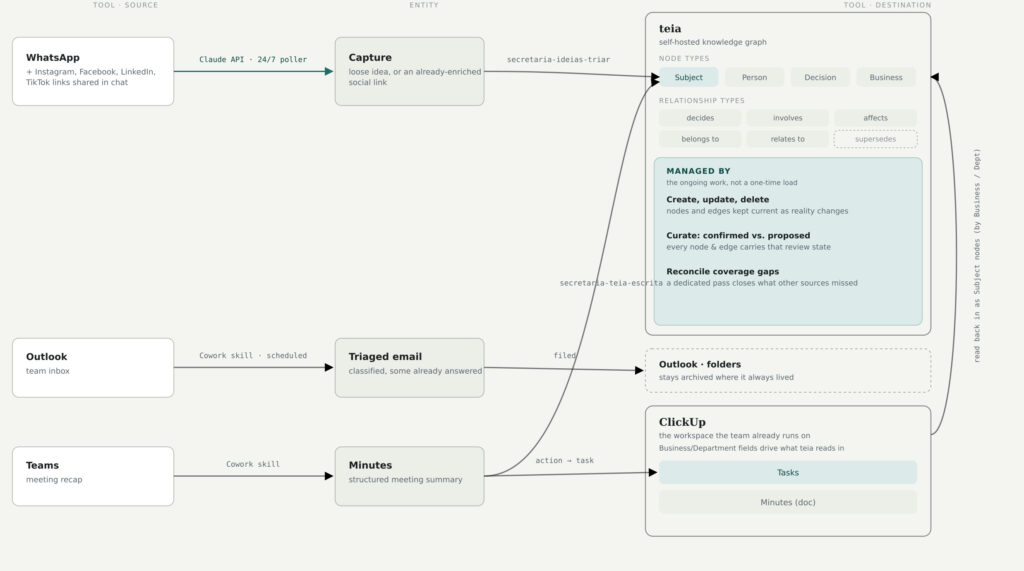
The highlighted arrow is the only one that calls the Claude API directly, with no Cowork session involved — every other arrow is a Cowork skill. ClickUp isn’t only a destination: the arrow running back from ClickUp into teia is existing tasks being read in as Subject nodes, keyed off ClickUp’s own Business and Department fields. Node and relationship types shown are teia’s actual schema categories, confirmed against the live database; the dashed one (supersedes) hasn’t been observed as an edge yet.
A flow, concretely: from a meeting recap to a tracked task, without a manual handoff
- A meeting happens. Someone shares the call recap link into the chat — no separate step to remember.
- Minutes get drafted. secretaria-atas-escriba writes the record against a shared framework, the same structure every meeting produces.
- Action items become real tasks. Each decision becomes a ClickUp task with an assignee, linked back to the minutes it came from — not a bullet point that dies in a document.
- The record stays queryable. Weeks later, secretaria-atas-leitor answers what was agreed — nobody re-opens the transcript.
Results: three places that used to break, and what happens there now
Meetings. Before: a call recap sat in a transcript nobody reopened, and action items lived in whoever remembered them until the next meeting. Now: minutes get drafted from the recap automatically, each action item becomes a ClickUp task with an owner linked back to where it came from, and what was decided is answerable weeks later without anyone rereading anything. At 10–15 meetings a week, that’s 10–15 threads a week that used to depend on someone’s memory and now don’t.
Ideas & social links. Before: a good idea mentioned in a WhatsApp chat, or a useful post someone saw on LinkedIn, stayed exactly there until it was forgotten. Now: WhatsApp messages and any social link shared alongside them get captured and filed automatically, around the clock, with no one needing to stop and paste anything anywhere — roughly five a day, every one of them landing in a queue instead of scrolling out of a chat.
Email. Before: the inbox built up overnight and got triaged whenever someone found a spare half hour — often after the day’s first meeting had already started. Now: a scheduled run works through it early — around a hundred emails a day for the one person using it today, spam and dead threads mixed in with what actually matters. When that routine once went silent for several days without erroring, the failure was traced to the architecture and fixed there — the job now runs as a persistent, self-bound session instead of a fresh one that could silently lose its tool access — not patched around.
Built like production: the same discipline we’d expect a client to hold us to
Skills are versioned with changelogs, not edited quietly in place. The capability registry alone has moved through seven versions since first written, each entry tied to a specific request and a specific date.
Not everything runs through Cowork, and that split is deliberate. WhatsApp capture has to keep working with nobody watching — no open session, no one at a laptop — so it runs as a standalone, always-on service that calls the Claude API directly, transcribing and filing what comes in and enriching any social link shared alongside it. Cowork skills pick up from there: the same queue feeds secretaria-ideias-triar, routed and reviewed the same way as everything else. Autonomous where it has to be, collaborative where a person is already in the loop.
Nothing an agent does that’s irreversible or could cost money runs unsupervised. It routes through an autonomy gateway first: a request goes out over Telegram, and nothing executes until a person approves it. Agents don’t hold a fixed level of trust, either — there are explicit rules for promoting one to more autonomy as it proves itself, and for pulling that back when it doesn’t.
The skills themselves go through the same scrutiny they enforce on everything else. Building one starts by forcing out what it’s actually for and what success looks like, and before it ships, a second, more capable agent reviews it adversarially — a routine change gets reviewed by Opus, anything genuinely complex escalates to a stronger reviewer. That second pass has caught real architecture problems during development, not just wording. The same discipline runs on the rules the system applies day to day: email triage works off a fixed, deterministic rule set, but the rules aren’t treated as final — the AI reviews them for gaps, proposes a fix where one shows up, and the revision gets checked again before it runs unsupervised.
Status: in active use, still growing
SecretarIA has been in continuous, real use since mid-2026, built against a five-phase roadmap that gets revised as real work surfaces what matters next — not a fixed spec written once and followed blindly.
- In use since: May 2026, continuously
- Skills in the suite: 14 live and growing — capture, minutes, knowledge graph, triage
- Systems connected: Outlook, WhatsApp, Teams, ClickUp, Instagram, LinkedIn, TikTok, Facebook, Threads, internal knowledge graph
Connecting the tools was never the hard part. What makes it work is the two layers on top of that: judgement, so the system knows what an email or a transcript is actually about — and a legacy, so every pass through it leaves something a person can go back to, a document, a task, a graph record tied to where it came from. The AI here isn’t only reasoning in the background; it’s producing artifacts a human reads, working the same pipeline a person does, handing off and picking back up, always under a person’s eye on what the AI itself is doing. Deterministic where it must be, Claude where judgement helps — always inside the tools people already use. It’s the same principle behind OrgAudit 360, our client-facing product; here, we just pointed it at ourselves first.